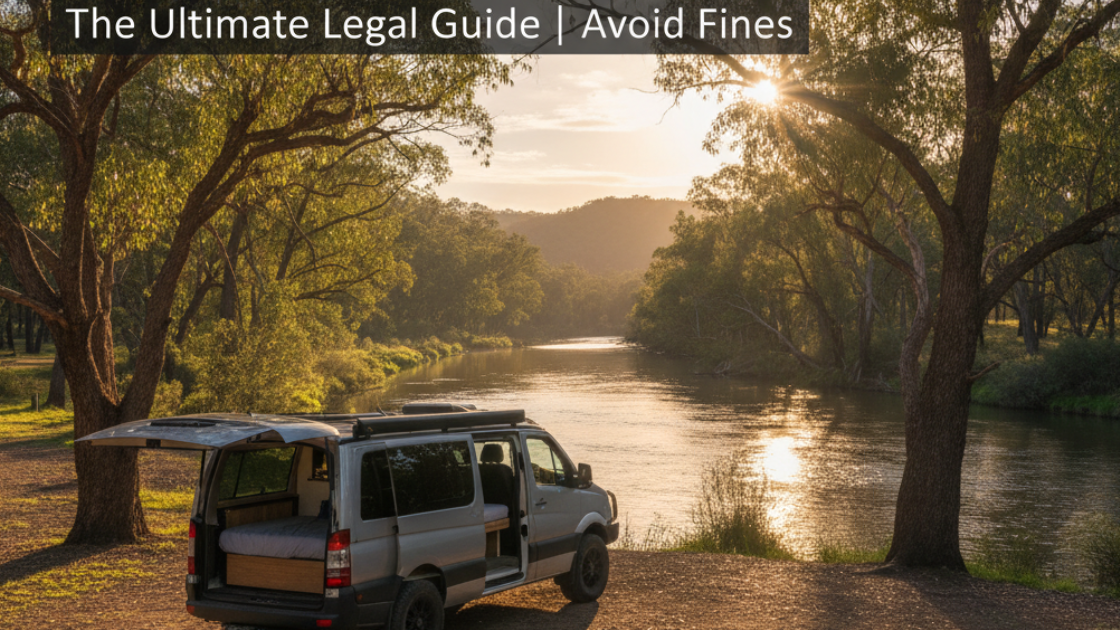
What Does ‘Free Camping’ Really Mean in Western Australia? (The Legal Framework)
Free camping near Perth offers an ideal opportunity to minimize travel costs and connect with the natural environment. However, Western Australia imposes stringent regulations on where travelers may legally stay overnight without charge. The widespread practice often referred to as “wild camping”—pulling over anywhere along a beach, roadside, or public land—is generally restricted or illegal, particularly near developed towns or tourist zone. Enforcement in popular areas, such as Margaret River, is frequent, and penalties for non-compliance can range significantly, sometimes incurring fines up to $1,000.2
The Critical Definitions: Rest Stops versus Wild Camping
In the Western Australian context, “free camping” specifically refers to staying in a designated campground or rest area where no fee is charged. This is distinct from unauthorized roadside stops. The vast majority of free sites available are rudimentary, offering little more than a clearing, possibly supplemented by simple toilets or a tap. Rules are complex and vary greatly depending on whether the land is managed by Main Roads WA, local government, or the Department of Biodiversity, Conservation and Attractions (DBCA).
The 24-Hour Rest Stop Rule (Main Roads WA)
A core component of budget travel near Perth is the utilization of clearly marked overnight rest stops provided along state highways. These areas are established primarily for public safety and convenience, intended to combat driver fatigue during long-distance travel. Crucially, the mandatory legal limit for use of these stops is 24 consecutive hours only.
A critical regulatory distinction exists between “resting” and “camping” at these 24-hour stops. While sleeping inside a vehicle is permitted, travelers must be careful not to create a recreational campsite. Enforcement officers observe external setup to determine compliance; rolling out an awning, setting up patio chairs, or deploying leveling jacks can be interpreted as illegal “camping”. If a traveler remains strictly inside their caravan or motorhome, they are considered to be resting to avoid fatigue, which aligns with the safety purpose of the rest area. If, however, they begin to set up a traditional camp structure, they risk incurring a fine, as roadside areas are not intended for long-term recreational setup. This implies that these 24-hour stops are designed strictly for self-contained vehicle accommodation, precluding traditional tent setups or extended leisure activity.
The Key Requirement: Why Self-Contained Vehicles Dominate
Given the tight environmental and logistical restrictions near metropolitan centers, many designated 24-hour sites explicitly or implicitly require vehicles to be fully self-contained. For instance, the Capel RV Stop strictly bans tents and mandates that caravans or campervans be self-contained. Self-containment is defined as having the capability to carry water and manage sewage and greywater for the duration of the stay without relying on external public amenities.
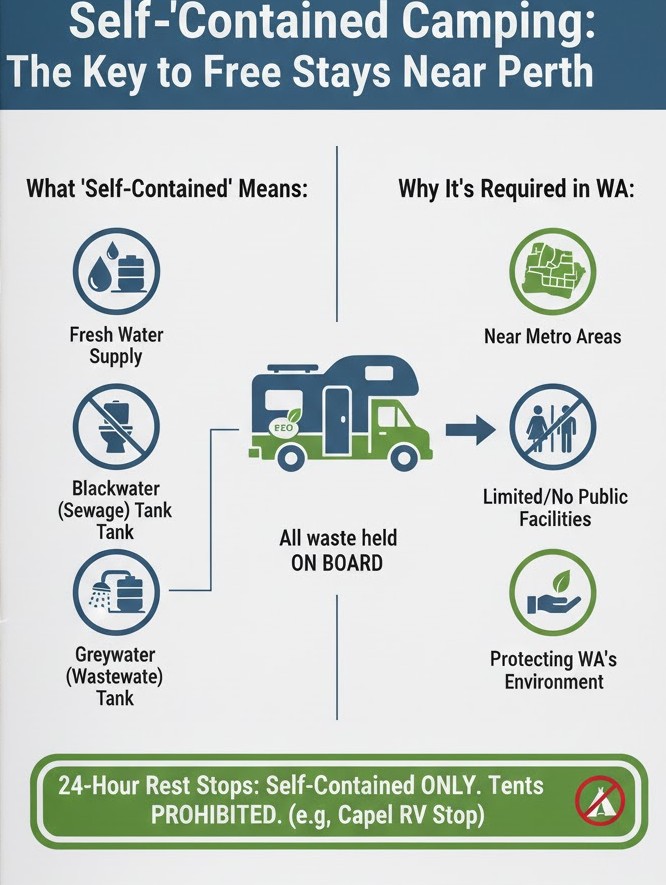
The proximity of free camping to Perth makes self-containment the single most important operational requirement for maximizing legal overnight parking opportunities. Local councils enforce this to minimize the necessity for public ablution facilities and prevent environmental degradation caused by liquid or human waste runoff. By restricting access to vehicles capable of managing their own waste, authorities ensure the sustainability of these often rudimentary rest areas for short stays.
Utilizing State Forests: The True Free Bush Camping Alternative
For travelers seeking a longer duration or a more traditional bush camping experience, State Forests offer the most liberal legal environment near Perth. Camping is generally permitted in some State Forests in Western Australia, with exceptions for specific metropolitan reserves. This stands in contrast to National Parks, which typically require payment and mandatory bookings.
State Forests are the only location where a traveler can legally stay for an extended period, with a maximum duration of up to four weeks often permitted. While dispersed camping (setting up camp away from established sites) is possible and free, many State Forests also contain designated, established camping areas that may offer limited facilities, such as toilets and fire pits.
Diving deep into free camping in perth
It is essential to understand the distinction between truly dispersed free camping in the bush and utilizing managed sites within the State Forest boundary. While the principle that “All State forests are free to camp in” holds true for unstructured bush camping, specific, developed campgrounds, such as the popular Marrinup Townsite Campground near Dwellingup, may charge a nominal fee (e.g., $8 per adult per night) for the maintenance of improved facilities. This low fee covers essential costs for maintained infrastructure like established toilets and picnic tables, ensuring long-term environmental sustainability and reducing the burden on land management bodies. For budget-conscious travelers, this distinction means that long-term stays are possible, either entirely free in dispersed bush areas or for a very low cost in managed, amenity-rich forest campsites.
Table 1 provides a detailed summary of the regulatory landscape for free camping near Perth.
Table 1: Western Australia Free Camping Regulatory Summary (Detailed)
| Camping Type | Typical Location | Cost | Max Stay Duration | Amenities Expectation | Legality Status |
| Designated RV Rest Stop | State Highways (Main Roads WA) | Free | 24 Hours (Strict limit) | Extremely basic (often just pull-off, sometimes dump point) | Legal (Requires self-sufficiency; Tents Prohibited) 6 |
| Designated State Forest Bush Camp | Non-metro State Forests (e.g., Dwellingup area) | Free | Up to 4 Weeks | Very minimal to none | Legal (Adherence to LNT mandatory) 11 |
| Established State Forest Campground | Specific sites within State Forests (e.g., Marrinup Townsite) | Nominal Fee (~$8-$10 p/p) | Varies (often multiple nights) | Toilets, fire rings, picnic tables | Legal (Best for non-RV campers) 14 |
| Illegal Roadside/Wild Camping | Beaches, parking lots, non-designated pull-offs | Free | Illegal | None | Illegal (Fines $200-$1000) 1 |
Eastern & Northern Escapes: Free Camps Within a 1.5 Hour Drive
The most accessible free camping spots within a short drive of Perth (75–120 km) typically serve as overnight rest areas for self-contained travelers. These sites offer the benefit of proximity while adhering to legal rest requirements.
Katrine – Viveash Reserve (Near Northam)
Located approximately 1 hour 15 minutes (94.4 km) east of Perth, Katrine – Viveash Reserve sits at the intersection of Northam-Toodyay and Katrine Roads. This location is highly valued because it is situated directly on the banks of the Avon River, offering a scenic backdrop for a short stay. The site is easily accessible for a variety of vehicles, including 2WDs, camper trailers, and caravans. Unlike many other 24-hour stops, Katrine – Viveash Reserve offers amenities that significantly enhance the traveler experience, including free toilets, rubbish bins, and reliable phone reception (Telstra and Optus 4G). Furthermore, it is explicitly pet-friendly and allows fires seasonally, provided campers bring their own firewood. This combination of facilities, accessibility, and the allowance for seasonal fires makes it a rare and valuable free listing near the metropolitan area. Travelers planning to utilize the fire pits must check local fire bans before lighting anything. A common feedback point is the occasional noise from the nearby main road and train tracks, though traffic usually subsides enough for a decent rest overnight.
Clackline Reserve (Great Eastern Highway)
Clackline Reserve is one of the closest verified free camping spots to Perth, located about 1 hour 6 minutes (78.9 km) drive off the Great Eastern Highway. This reserve is noted for its spacious layout and peaceful, natural atmosphere, making it a popular destination for outdoor activities such as picnics or bike riding.
Clackline is highly suitable for travelers seeking reliable connectivity, as it provides free phone reception (Telstra 4G). Additional facilities confirmed by user reports include toilets, fire pits, and picnic tables. This reserve functions as an excellent, easily accessible pit stop for those traveling the eastern corridor, offering immediate bush access alongside essential basic amenities.
Avon Park & Gwambygine Park (York Area)
The historic town of York, roughly 1.5 hours east of Perth, features a cluster of public areas that require careful navigation to determine legal overnight parking zones.
Avon Park, located in Lowe Street, is a large, highly popular grassed area running alongside the Avon River. It serves as a community amenity hub, featuring excellent free facilities, including electric BBQ units, picnic tables, toilets, and a Nature Play playground. However, this park is primarily for day use.
The designated, legal overnight rest stops are located separately and adhere to strict 24-hour limits. Gwambygine Park, located 11 km south of York, is one such designated area, offering a bush experience with toilet facilities, free gas BBQ facilities, and picnic areas.
An alternative is the Janet Millet Lane RV Rest Stop, situated on the opposite side of the river from Avon Park. This particular site is unpowered and critically, has no ablution facilities. The Shire of York mandates that vehicles using Janet Millet Lane must be fully self-contained.
This separation is crucial: travelers must not mistake the amenity-rich Avon Park as a free overnight camping spot. That area is reserved for day use. Instead, the legal overnight options (Gwambygine and Janet Millet Lane) are more rudimentary and strictly enforce the 24-hour time limit and self-contained mandate. This enforcement protects the municipal area from unauthorized camping and ensures compliance with health regulations.
Table 2: Northern/Eastern Free Camp Comparison
| Campsite | Drive Time (Approx.) | Key Amenities | Vehicle Suitability | Key Attraction/Atmosphere | Primary Restriction/Note |
| Katrine – Viveash Reserve | 1 hr 15 min (94 km) | Toilets, Fire Pits, Phone (4G) | RVs, Trailers, Caravans (Pet Friendly) | Riverside, Birdwatching | Road/Train noise potential, 24-hour limit typical [17] |
| Clackline Reserve | 1 hr 6 min (79 km) | Toilets, Fire Pits, Phone (4G) | All Types | Peaceful bush setting, close to highway | Basic amenities, 24-hour limit 15 |
| Gwambygine Park (York) | ~1.5 hours | Toilets, Gas BBQ | RVs/Vans | Bush experience, picnic areas | 24-hour limit, self-contained recommended 19 |
Southern Corridor Stays: Rest Stops and State Forest Gems
The southern corridor from Perth offers excellent free options, primarily along the South Western Highway, providing crucial staging points for trips further south toward the Dwellingup and Margaret River regions.
Blythwood Rest Area & Blythwood South Rest Area
These two rest areas, located along the South Western Highway about 1 hour 2-3 minutes (92–95 km) south of Perth, are highly regarded for travelers with recreational vehicles and pets.
The sites offer key logistical support, including confirmed free phone reception, with coverage available across both the Telstra and Optus 4G networks. They are recognized as clean, quiet, and well-maintained spots designed for short overnight breaks. Their placement makes them an ideal staging location for adventurers planning to explore the vast wilderness of the Dwellingup State Forest, located just a short distance further south.
Pinjarra RV Rest Area
The Pinjarra RV Rest Area is a critical piece of infrastructure for self-contained travelers heading south, located approximately 1 hour (85 km) from Perth, just off Pinjarra-Williams Road.
This is a strictly regulated 24-hour rest stop that can accommodate up to 15 caravans or recreational vehicles. While it provides shade and confirmed phone reception (Telstra/Optus 4G), its most valuable feature is the free dump point located nearby. Because the site lacks other facilities, visitors are required to be fully self-sufficient. The availability of a dump point free of charge close to the Perth area makes Pinjarra an essential logistical stop for travelers adhering to self-contained regulations.
Marrinup Townsite (Dwellingup State Forest Access)
Marrinup Townsite Campground, situated approximately 5 km north-west of Dwellingup, provides access to the true bush camping experience of the State Forest system. The journey from Perth typically takes about 1 hour 45 minutes.
The site is an open, grassed area set on the remnants of an old town, popular for bushwalking and mountain biking. Access is available for 2WD vehicles, although road conditions are variable, and visitors are advised to contact the Dwellingup Visitor Centre for current conditions before arrival.
For travelers seeking long-term accommodation, Marrinup offers an excellent alternative to restrictive 24-hour roadside stops. It must be noted, however, that Marrinup Townsite is designated as an established campground, not just dispersed bushland. While State Forests broadly allow free bush camping , specific managed sites like Marrinup Townsite Campground levy a nominal fee for use of the improved facilities, such as toilets. The fee is typically low (around $8 per adult per night). This structure supports the continued maintenance of facilities and is highly budget-friendly, aligning with the low-cost camping alternatives available in the region. This small charge provides travelers, particularly those tent camping or seeking a multi-night stay, with reliable facilities within a magnificent forest setting.
Critical Compliance: Fire Regulations and Seasonal Bans
Safety and environmental compliance are paramount when free camping near perth & Western Australia. The environment is frequently characterized by hot, dry conditions and distance from emergency services, leading to an exceptionally high risk of bushfire. Compliance with fire regulations is non-negotiable, and heavy penalties apply for any violation.
Seasonal Restrictions and Mandatory Checks
A major regulatory constraint for free campers is the seasonal fire restriction. Generally, a solid fuel ban is imposed during the hottest months, meaning campfires are not permitted at any time of day or night from December 1 to March 31 inclusive. This period may be extended or varied based on specific regional conditions and annual weather patterns.
Because fire conditions can change rapidly and unpredictably, travelers must treat fire safety as the primary operational constraint of any trip. Before lighting any fire, mandatory checks of real-time conditions must be performed daily using official sources, such as Emergency WA and the DBCA Current Campfire Conditions table.
Firewood Protocol
Strict rules govern the use of fuel sources for cooking and warmth. Fires are only allowed within designated fire rings or pits provided at the campsite. Crucially, the collection of firewood and kindling is prohibited within National Parks and other conservation reserves. Since firewood is rarely provided at free sites, campers must either bring their own (BYO) firewood or rely exclusively on gas cooking appliances. During the summer fire ban season, gas appliances become the only legal means of cooking. Any traveler utilizing a free camp that seasonally allows fires (such as Katrine – Viveash Reserve) must ensure they have their own legal fuel source and be prepared to abandon wood fires immediately if a fire ban is declared. Failure to completely extinguish all fires before leaving an area or retiring for the night is a severe offense, as even a stray ember can trigger a catastrophic bushfire.
Leave No Trace (LNT) Principles for WA Campers
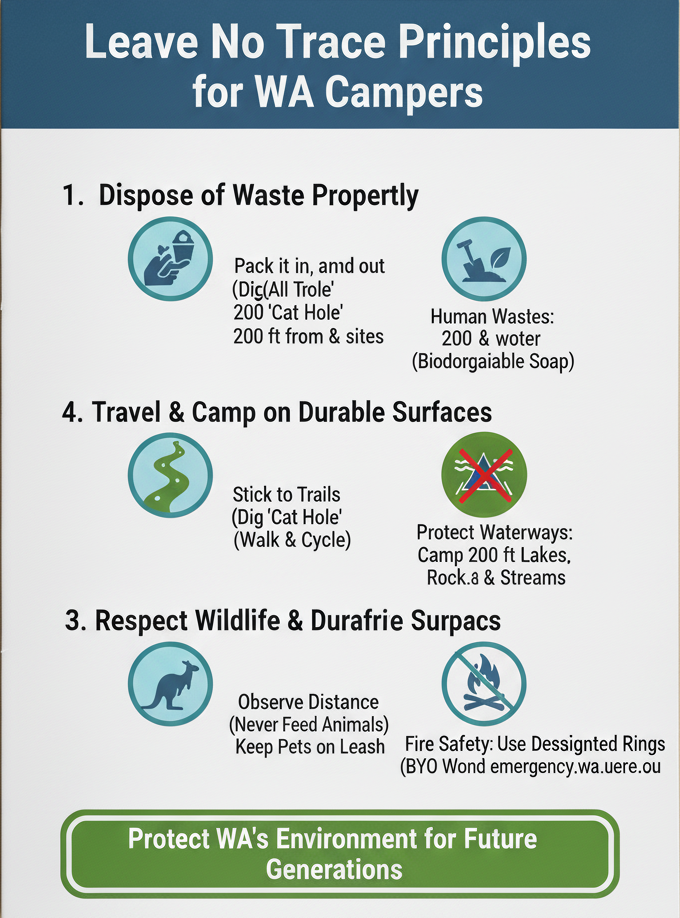
The ethical framework for using public lands in WA is governed by the international Leave No Trace (LNT) principles. Adherence to these guidelines ensures the delicate Western Australian environment remains accessible for future generations.
Dispose of Waste Properly
The most critical LNT principle, especially at free camps with limited or no facilities, is the proper disposal of waste. All trash must be carried out (“pack it in, pack it out”), which includes food scraps and all packaging. If a designated toilet is not available, human waste disposal requires digging a small “cat hole” at least 200 feet (about 60 meters) away from water sources, trails, and campsites, and immediately covering the hole upon completion. Furthermore, washing dishes or oneself must be done 200 feet away from lakes and streams, using minimal, biodegradable soap, and scattering the strained dishwater.
Travel and Camp on Durable Surfaces
To protect fragile bushland and vegetation, campers must stick to established trails and designated camping areas. Durable surfaces include gravel, rock, dry grasses, or established campsite clearings. Travelers must avoid setting up camp in new areas where environmental impacts are just beginning, and should maintain a distance of at least 200 feet from lakes and streams to protect aquatic habitats.
Respect Wildlife and Campfire Impact
Respecting native fauna involves viewing animals from a distance and never feeding them, intentionally or otherwise. Pets must be controlled and kept on a leash in areas where they are permitted, preventing them from harassing local wildlife. Finally, minimizing campfire impact requires using only established fire rings and ensuring the fire is entirely cold to the touch before departure or sleep.
Tech and Planning Essentials for Success
Effective planning is essential for a safe and legal free camping experience. The most reliable resources for identifying free camp boundaries, checking current user reviews, and verifying amenities and stay limits are community-driven platforms such as WikiCamps and Camps Australia Wide. These tools provide the necessary real-time data that static maps often lack. For official land status, fire bans, and specific campground details within State Forests, the DBCA Explore Parks portal is indispensable.
Most of the key, legal 24-hour rest areas near Perth, including Blythwood and Pinjarra, benefit from confirmed mobile reception across the major carriers (Telstra and Optus 4G).15 This reliable connectivity is vital, allowing travelers to check emergency warnings and fire danger ratings while on the road.
When Free is Full: Low-Cost Camping Options Near Perth
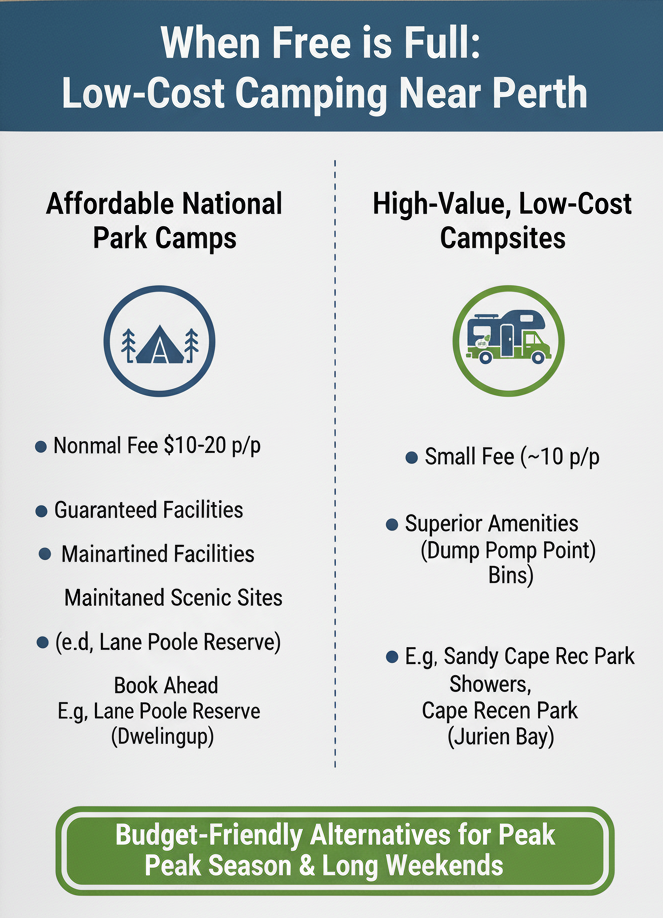
Given the scarcity of genuinely free, legal, and amenity-rich campsites near the Perth metropolitan area, travelers should have budget-friendly alternatives prepared, especially during peak season or long weekends.
The Affordable National Park Camps
Many of Western Australia’s national park campgrounds are highly affordable, generally priced between $10 and $20 per person per night. While these are not free, the nominal fee often grants access to guaranteed facilities, maintained sites, and highly scenic locations such as those in the Dwellingup area (e.g., Lane Poole Reserve). For travelers who are not fully self-contained or who prefer the convenience of booking ahead, these inexpensive sites provide a necessary safety net. For instance, the Perth Hills Discovery Centre Campground is open Friday through Sunday nights and during public school holidays, requiring a booking.
High-Value, Low-Cost Campsites
Some locations slightly further from Perth operate on a low-fee model to support the maintenance of improved infrastructure, resulting in facilities superior to most 24-hour rest stops. Sandy Cape Recreation Park, located approximately 230 kilometers north of Perth (near Jurien Bay), is a prime example. This coastal campsite charges a small fee of $10 per adult per night and offers high-value amenities including toilets, showers, a dump point, and bins. These low-cost sites offer a significant boost to the budget traveler’s experience without the regulatory limitations and lack of facilities found at strictly free 24-hour stops.
Conclusion: Planning Your Perth Free Camping Adventure
Free camping near Perth is a rewarding experience, but success hinges entirely on understanding and adhering to Western Australia’s strict regulatory environment. The analysis confirms two primary legal pathways for free stays: the strictly enforced 24-hour roadside rest stops intended for fatigue management by self-contained vehicles, and the State Forest system, which allows longer stays and traditional bush camping, often for free in dispersed areas, or for a nominal fee at managed sites like Marrinup Townsite Campground.
Travelers must prioritize safety by strictly complying with fire regulations, particularly the seasonal solid fuel ban (generally December to March), and must secure their own firewood or rely on gas appliances. Given the limited facilities at many free sites, full self-containment for RVs and adherence to Leave No Trace principles are mandatory standards of operation. By utilizing digital tools to verify real-time status and differentiating between day-use areas (like Avon Park) and legal overnight rest stops, budget-conscious travelers can maximize their enjoyment of WA’s natural environment while avoiding significant legal penalties.